
DefendR is an easy-to-understand approach that highlights the superior harvest management and disease
resistance genetics developed by our primary canola breeding partner, DL Seeds.
The DefendR trait platform is gene-driven and can be an important piece of your overall canola management and production strategy. BrettYoung uses the DefendR designation to signal genetic tolerance to pod shatter and durable resistance to two prominent disease complexes affecting canola: clubroot and blackleg.

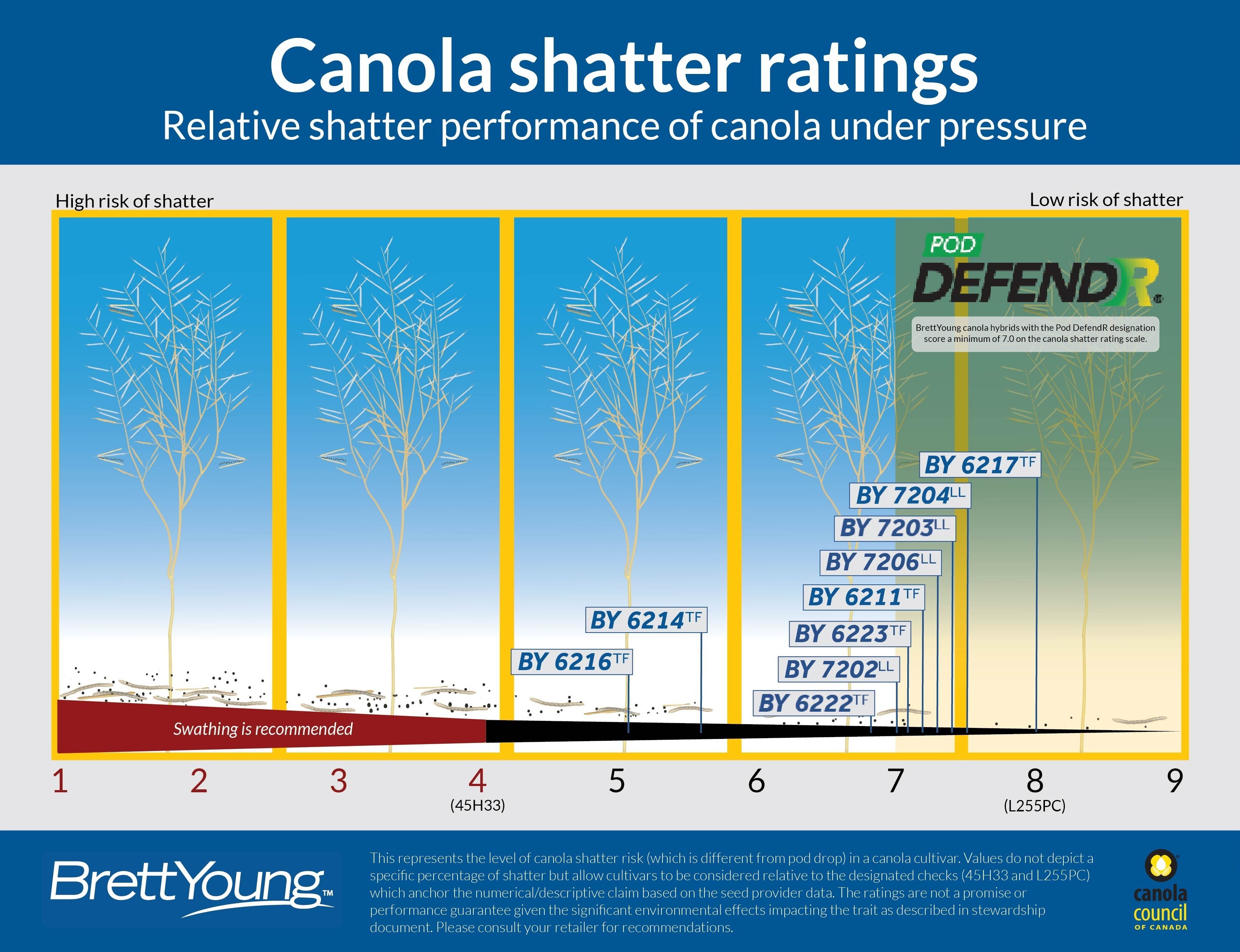
A dependable level of shatter tolerance, well suited to straight-cut or delayed swathing harvest systems. Pod DefendR-rated hybrids score a minimum of 7.0 on the Canola Council of Canada’s canola shatter rating scale.

Stacked 1st and next-generation clubroot resistance genes that protect against the prevalent pathotypes (3A, 3D, and 3H). Clubroot DefendR also protects against common (8E, 8N, 8P), and frequent (5C, 5G, 5L, 8A, and 8D) pathotypes, and against many other infrequent, rare, and new pathotypes.
.

Contains one or more major blackleg resistance genes that align with predominant blackleg race(s), combined with a strong R-rating for adult plant (quantitative) blackleg resistance.
The introduction of pod shatter-resistant hybrids to canola growers several years ago led to a significant increase in adoption of both direct harvesting and delayed swathing of canola crops. BrettYoung canola growers can now enjoy this same flexibility because of our new pod shatter resistance trait, which delivers a dependable level of shatter tolerance.
Pod shattering, and the seed dispersion associated with it, is a survival mechanism found in nature and, despite decades of breeding and domestication, canola pods still have a natural tendency to split and open at maturity, with the goal of scattering seeds. Plant breeders and trait developers have been working to understand the physiology of canola pod ripening and pod shatter mechanisms.
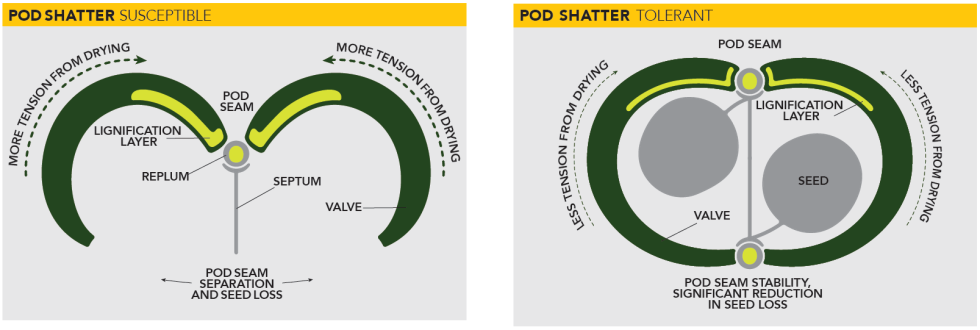
DL Seeds, and its parent companies, have researched their own solutions, and what has emerged is an understanding of a complex pathway of gene interaction that controls pod valve function.
Much of this work has meant isolating specific genes from other brassica species and breeding them into canola to interrupt these shatter-inducing pathways. If you’ve ever grown mustard, you’re aware of the substantial pod shatter resistance in that crop.
The result is Pod DefendR, a specific genetic trait that reduces pod tension built up at maturity and ultimately, the tendency for canola pods to split at the pod dehiscence zone (pod seam) that holds both sides of the pod (valves) together.
Clubroot is now established in all three Prairie provinces. Since 2013, when the first resistance-breaking
pathotype was identified in Alberta, several new and more virulent pathotypes have evolved that can evade
what is known as 1st generation (Mendel-type) resistance. Stacked 1st and next-generation clubroot resistance genes that protect against the prevalent pathotypes (3A, 3D, and 3H). Clubroot DefendR also protects against common (8E, 8N, 8P), and frequent (5C, 5G, 5L, 8A, and 8D) pathotypes, and against many other infrequent, rare, and new pathotypes. DL Seeds has a robust pipeline coupled to high-performance hybrids that BrettYoung will continue to commercialize to support you in keeping one step ahead of this impactful disease.
Blackleg is a disease that has made a resurgence in intensive canola production areas. Most agree that a combination of crop rotation, crop management (including regular field scouting), and proper hybrid selection are important factors to reducing the impact of this disease.
The Blackleg DefendR trait means the BrettYoung canola hybrid contains one or more major blackleg resistance genes that align with predominant blackleg race(s), combined with a strong R-rating for adult plant (quantitative) blackleg resistance.